
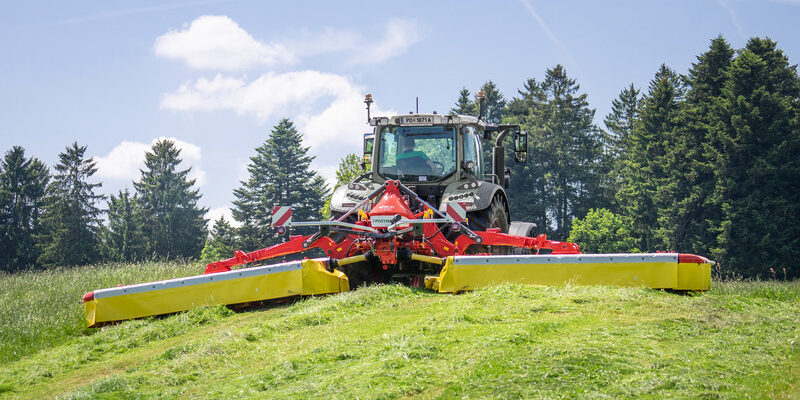
As mower combinations continue to grow in size and output, one challenge has become increasingly apparent. Building a machine capable of covering nine metres of ground is relatively straightforward. Building one that can maintain cutting performance, adapt to varying front mower combinations, follow uneven terrain and transport safely between paddocks is considerably more difficult.
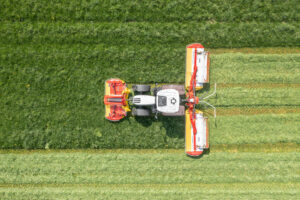
Positioned between the company’s fixed-width S-Series mower combinations and the larger V 10000, the V 8400 and V 9200 have been designed around one key principle: flexibility. Rather than offering a single fixed working width, these mower combinations allow operators to vary overlap and working width depending on tractor setup, terrain and front mower configuration. The result is a machine that can adapt to a wider range of operating conditions without compromising cutting quality or productivity.
The engineering starts with the centre-pivot mounting system.
Unlike side-pivot mower combinations where each mowing unit is supported from one side, the Novacat V-Series uses a centre-mounted suspension arrangement. This enables the cutter bars to float more evenly across the full cutting width while maintaining more consistent ground pressure. Pöttinger’s development work around what it refers to as “floating cut” technology has focused on ensuring the cutter bar follows the ground rather than being forced into it. The objective is to maintain cutting consistency while reducing power requirements and contamination risk.
The V 8400 offers a variable working width from 8.12m to 8.36m, while the larger V 9200 extends from 8.95m to 9.20m. That adjustment may sound relatively modest on paper, but it plays an important role in maintaining overlap between the rear mower units and the front mower. Different tyre sizes, track widths and operating conditions can all influence overlap requirements. By allowing the rear units to be adjusted hydraulically, operators can optimise coverage while minimising unnecessary overlap and wasted power.
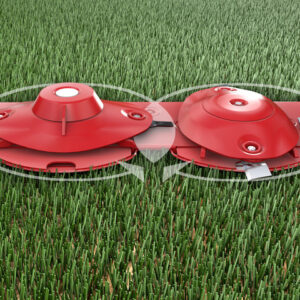
Optimized blade overlap – for clean cutting
In practice, this means the mower combination can be tailored to suit a range of front mower configurations rather than forcing operators into a fixed setup.
The suspension system is equally significant.
Large mower combinations generate substantial dynamic loads as they move across uneven terrain. Maintaining consistent ground pressure across the cutter bar becomes increasingly important as working widths increase. Excessive pressure creates wear and contamination while insufficient pressure can compromise cut quality.
Pöttinger addresses this through a suspension arrangement designed to distribute load evenly across the cutter bar. The centre pivot concept allows each mowing unit to react independently to terrain variations while maintaining support across the full cutting width. This becomes particularly important on rolling country where one side of the machine may be operating under very different conditions to the other.
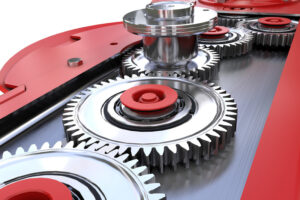
TriDrive
At the cutting interface, the V-Series benefits from the same cutter bar technology used throughout Pöttinger’s premium mower range.
Manufactured in Austria, the cutter bar features a remarkably low-profile design measuring just 4cm in height and 28cm in width. This geometry allows the cutter bar to follow ground contours closely while promoting efficient crop flow across the mower bed. Integrated cleaning paddles prevent material accumulation on the cutter bar surface while the oval disc design improves crop transfer through the machine.
The welded cutter bar construction also plays an important role.
Rather than relying on multiple bolted sections, the welded design provides strength while maintaining a compact profile. An additional benefit is long-term sealing integrity, helping keep oil where it belongs and reducing the risk of leakage over the life of the machine.
Power transmission is handled through Pöttinger’s well-established Tri Drive system.
This driveline design uses a straight-line arrangement of large bevel gears operating within an oil bath. One of the standout engineering features is that three gear teeth remain engaged simultaneously during operation. By spreading load across multiple contact points, stresses on individual gear teeth are reduced while power transmission remains smooth and efficient. The gear surfaces are precision ground to reduce noise and improve durability under heavy workloads.
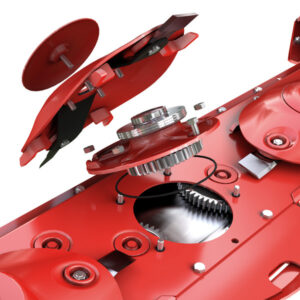
Disc Module
For contractors and large-scale operators, durability is a major consideration.
The V-Series incorporates twin-race taper bearings supporting the mower discs, with bearing spacing designed to absorb shock loads effectively. High-strength stub shafts are bolted directly to the gear assemblies, allowing individual components to be replaced if required. The modular cutter bar construction also simplifies servicing, with gear and bearing assemblies removable as complete units.
Conditioning options further expand the machine’s versatility.
Both the V 8400 and V 9200 are available with either the Extra Dry (ED) tine conditioner or the RC roller conditioner. The ED system uses hardened V-shaped steel tines mounted on flexible rubber blocks to aggressively condition forage and accelerate moisture loss. Conditioning intensity can be adjusted by altering the gap between the tines and counter flap, allowing operators to match performance to crop conditions.
For crops such as lucerne and clover, the RC roller conditioner offers a different approach. Intermeshing polyurethane-profile rollers crimp stems rather than striking them, helping preserve leaf material while still promoting rapid drying. Roller pressure and spacing are adjustable, while the system can accommodate foreign objects by opening up to 120mm between rollers when required.
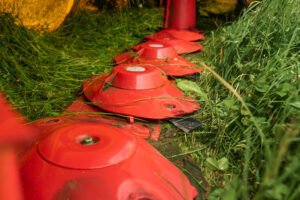
Cutterbar – Cutting performance
Output figures underline the capability of the platform. The V 8400 is rated at up to 10 hectares per hour while the V 9200 increases that figure to 12 hectares per hour. Working widths approaching nine metres allow operators to cover large areas quickly while maintaining the flexibility required to suit varying operating conditions.
Ultimately, the Novacat V 8400 and V 9200 are not simply larger mower combinations. Their engineering focus is centred on adaptability. Variable working widths, centre-pivot suspension, advanced cutter bar technology and interchangeable conditioning systems combine to create machines capable of adapting to a wide range of crops, tractors and field conditions.